Jess Olson
Jess Olson
Early Childhood Classroom Teacher
Lessons Learned
- One of the most foundational needs of young children is the understanding that they are safe and cared for. A few years ago, I had a student who had experienced every possible toxic-stress inducing event that you can imagine in her short five years. She came to school each day in fear. She spent hours every day screaming, trying to escape, and fighting an internal, emotional battle we as her teachers couldn’t even begin to understand. I could see her pain, and while I had been trained on social-emotional practices, this level of emotional distress required more than deep breathing and social stories could fix. Her most basic needs were not being met, and until those most foundational needs for safety, trust, connection, and control were met, school would never feel like a secure place for her. When children don’t even feel safe in our room, how can we expect them to learn and grow? Addressing this basic, foundational need for children intentionally in my practice and in my classroom environment became top priority going forward.
- Through my graduate coursework, I have been able to learn about the impacts that maltreatment and trauma can have on the body and the brain, particularly in early childhood when development occurs so rapidly and so significantly. There seems to be a common misconception that once a student has experienced maltreatment or trauma, their brain is permanently “damaged”. However, my coursework has helped me to understand the growing body of research that shows the brain can recover, so to speak, from the changes that occur as a result of toxic stress. This has helped me to understand that while we cannot change what a child has experienced, we can change how we view their experiences and how we as adults respond to students and their experiences. Being able to recognize how I needed to change in response to my students needs was a difficult and vulnerable path, but reframing my perspective in this way has significantly helped me to better support my students. In this regard, it was also a difficult lesson to learn that there is no “quick fix” when it comes to supporting students who have experienced maltreatment and trauma. When I saw students in pain, my immediate response was also to fix it or to make the pain go away. It took time and patience to reframe my perspective on the time it takes to support a child in healing, and to trust the process of reframing your perspective and implementing foundational changes in practice.
- There is a significant need for more in-depth, ongoing professional development for teachers surrounding the maltreatment and trauma of students with disabilities. I have developed my practice and understanding through direct experience in working with students with disabilities who have experience maltreatment or trauma and guidance from our student support team. Professional development played a minimal part in the way my practice has developed in this area. Many teachers do not have the training, understanding, and skills in practice to respond appropriately to students who have experienced trauma or maltreatment. This is not for lack of empathy or compassion for students, but missing knowledge. Further, one-day training that is most often presented to educators is not sufficient in building this knowledge. Engaging in ongoing, collaborative training with related service providers to build knowledge, skills, and understanding is essential to supporting teachers in supporting students most effectively.
Resources Developed
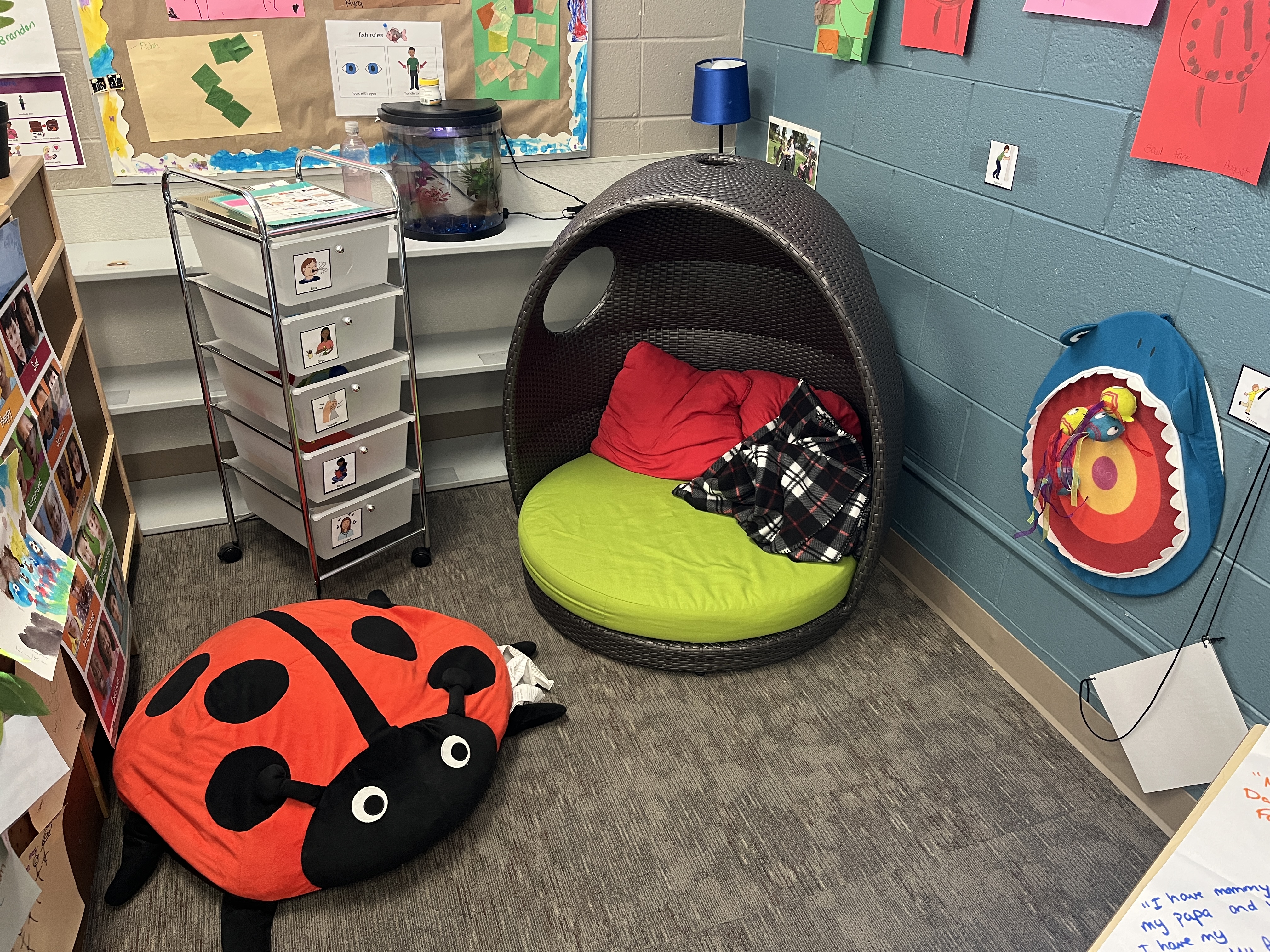
- Safe Space
- This space in our classroom is explicitly taught as an area where you can safely feel any feelings you may have. It is equipped with all the tools that we teach and model on a regular basis for emotional regulation. It corresponds with our “I feel/I need…” visual board to support understanding, selection, and use of the strategies.
- “I Feel - I Need…” visual
- This visual contains a multitude of strategies and tools that students can use in response to big feelings. We emphasize in our classroom that it is always okay to feel whatever feelings you may have, but you always need to do so safely. These tools are safe alternatives to behaviors that may occur as a response to big feelings. The tool helps students identify how they are feeling, and then give them a sense of control by letting them choose how they respond to the feeling. The tool is designed to be individualized as needed based on what works for individual students by reducing or adding visuals, matching the labels of the locations of the tools to the visuals on the board for easy access, and independent or supported use.
- Safekeeping box and Safekeeping Social Story
- This is our classroom’s version of the Safekeeping Ritual from Conscious Discipline. It is our daily commitment and reminder that our job as a classroom community is to keep each other safe, and that my job as their teacher is to keep everyone safe. This is an essential part of our this is an essential part of our daily routine as it re-establishes the priority we place on safety and security.
Suggested Resources
- Related service providers, student support team in our building. I collaborate heavily with our speech therapists, occupational therapists, physical therapists, and school psychologists and social workers, as well as our student resource leaders and curriculum coaches in order to continue to develop my practice, problem solve student supports, and ensure positive, safe approaches to supporting students in all areas of their development. I also participate in practice-based coaching related to the pyramid model for ongoing development of my practice related to inclusion and social-emotional development.
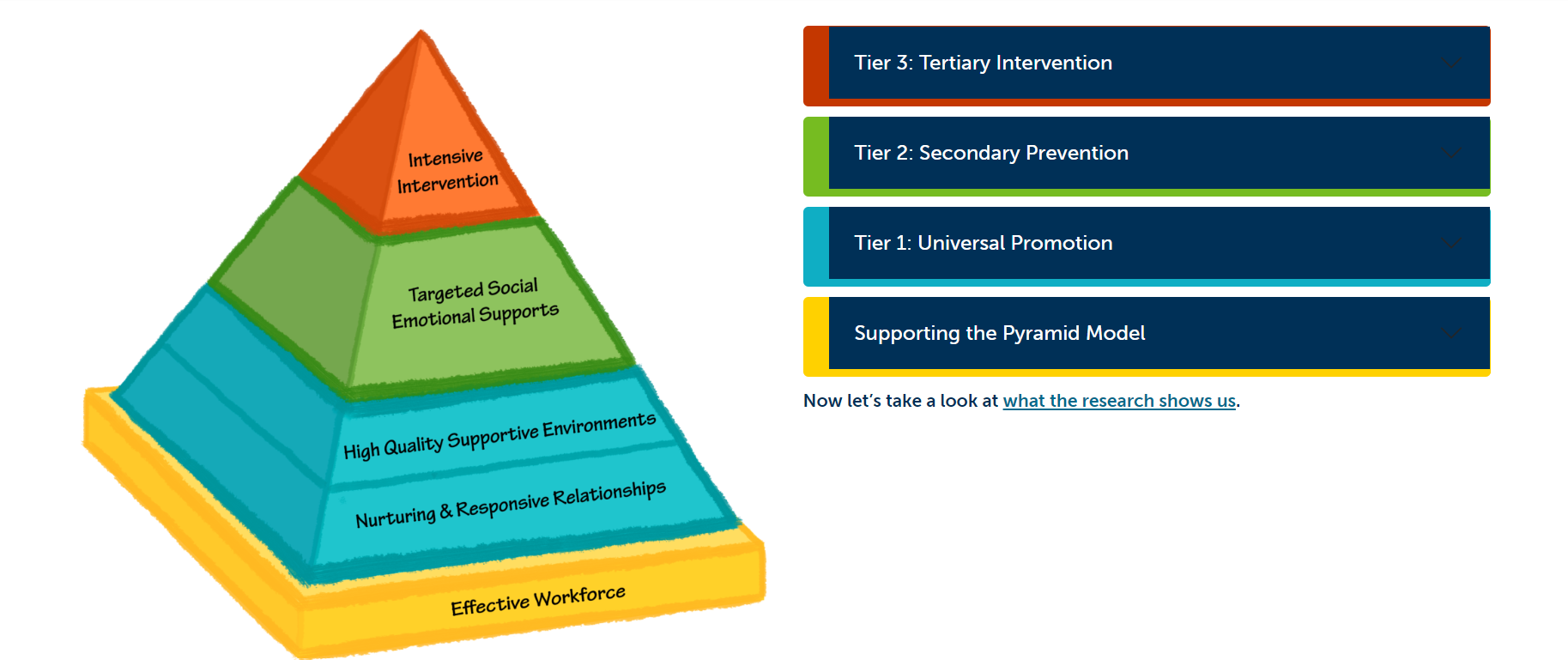
- Pyramid Model
- Our building uses the pyramid model to support social emotional development of all students and support families in understanding and using social emotional strategies. The Pyramid Model has become the foundation upon which we build our environment, practice, and relationships with our team, with our students, and with our families. We embed pyramid model practices into everything we do each day.
- Collaboration with colleagues.
- During my graduate coursework, I engaged in an action research project (“Supporting Cross-Program Collaboration to Enhance Inclusion Practices”) that highlighted the benefit of collaboration with teachers across programs to support development of inclusion practices. Through this process, I developed relationships with teachers in our self-contained programs that have become an invaluable resource. They have supported me in creating and sharing resources that will support students in my classroom, provided guidance on accommodations and adaptations, and helped reframe my perspective many times when it comes to identifying and solving a concern with students with disabilities. This kind of relationship with teachers from across programs provides insight into first-hand experience from others that cannot be acquired in other ways.
Collaborative Areas of Interest
- Professional development to support teachers in supporting students who have experienced trauma or maltreatment
- Supporting families in understanding their rights related to their child
- Supporting families in finding and utilizing community-based resources, implementing strategies at home, general support of families
Posted:
3 November, 2023
Category: